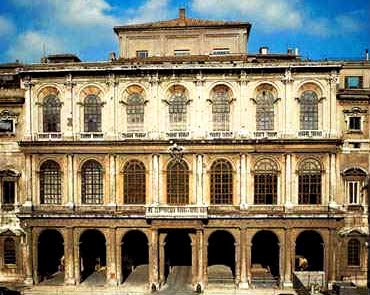
Living part of the national art collection in Italy (the rest is in the Palazzo Barberini, P103), the 16th from the Century Palazzo Corsini has a remarkable history. Michelangelo, Bramante and Erasmus all stayed here, but the Palazzo is most likely to Queen Christina of Sweden, took up residence in 1662 and maintained a steady stream of lovers in their bedrooms connected rich with frescoes. Gallery highlights include van Dyck's splendid Madonna della Paglia (Madonna of the straw), Murillo's Madonna col Bambino (Madonna with Child), and a typical haunting Caravaggio, San Giovanni Battista (John the Baptist), 3 in room The paintings of the Bologna school in room 7 also considered, with works by Guido Reni, Agostino and Annibale Carracci, Giovanni Lanfranco and Guercino.
Showing posts with label Museums in Italy. Show all posts
Saturday, February 26, 2011
Galleria Nazionale d'Arte Antica di Palazzo Corsini
Author: Yunus
| Posted at: 9:52 AM |
Filed Under:
Galleria Nazionale d'Arte Antica di Palazzo Corsini,
Museums in Italy
Galleria Nazionale d'Arte Antica di Palazzo Corsini
Living part of the national art collection in Italy (the rest is in the Palazzo Barberini, P103), the 16th from the Century Palazzo Corsini has a remarkable history. Michelangelo, Bramante and Erasmus all stayed here, but the Palazzo is most likely to Queen Christina of Sweden, took up residence in 1662 and maintained a steady stream of lovers in their bedrooms connected rich with frescoes. Gallery highlights include van Dyck's splendid Madonna della Paglia (Madonna of the straw), Murillo's Madonna col Bambino (Madonna with Child), and a typical haunting Caravaggio, San Giovanni Battista (John the Baptist), 3 in room The paintings of the Bologna school in room 7 also considered, with works by Guido Reni, Agostino and Annibale Carracci, Giovanni Lanfranco and Guercino.
National Gallery of Ancient Art of Barberini Palace
Author: Yunus
| Posted at: 9:48 AM |
Filed Under:
Barberini Palace,
Museums in Italy,
Museums in Roma
Both Bernini and Borromini had a hand in the design of the Palazzo Barberini, another symbol of papal patronage, with half of the National Gallery of Art (The other half remains to be united in the Corsini Palace, on the other side of the Tiber, the collection when the officers of the Army Club on the ground floor of the Barberini, a move that has been pending for about 50 years removed.) The paintings range from the Middle Ages to the 18th Century and include masterpieces by Raphael, Caravaggio and Pietro da Cortona, who is also the spectacular ceiling fresco, The Triumph of Divine Providence. "
Newly renovated, the museum paintings by Italian artists, as well as Dutch and Flemish works.
Palazzo Barberini is another Roman palace worth visiting for its splendor and collection of art. In 1625 the family bought the Palazzo Barberini Sforza and other real estate in the area, look at the Barberini Palace, we now should be taken in Rome. After the death of Carlo Maderno, the first architect of the project, Gian Lorenzo Bernini succeeded as chief architect in 1629th Bernini, the idea of the high central "Salone", which extends through two floors of the castle. Salone culminates in the great vaults, where Piero da Cortona frescoed his divine providence, a pictorial celebration of the spiritual and worldly glory of the Barberini. Cortona also had a hand in the building of the castle: the greatest of his contributions was the design of the theater wing, in 1926 with the opening of the modern Via Barberini.When Maffeo Barberini became Pope Urban VIII demolished in 1623 he decided to build a large family was asked palazzo.Bernini the facade overlooking the garden and stairway design. Borromini was commissioned to the spiral staircase and window to the top story of the palace design. most colorful room in the Gran Salone, with its illusory. Ceiling frescoes by Pietro da Cortona, the Barberini collection is mainly of Italian painting from the thirteenth to the sixteenth century, with works by Fra Angelico, Filippo Lippi, Lorenzo Lotto, Andrea del Sarto, Perugino, Caravaggio, Canaletto and Raphael Judith and Holofernes. Thanks .. Caravaggio's painting of the artist during his stay in Rome under the patronage of Cardinal del Monte was realized the strong contrast between light and shadow and its tragic realism typical of the artist style and provoked great controversy Et in Arcadia Ego. By Guercino - 1618 It is one of the most famous paintings Guercino, what the discovery of a skull by two young shepherd boy, the artist finds a perfect harmony between his Venetian reminiscence and his personal sensitivity
The Capitoline Museum
Author: Yunus
| Posted at: 9:45 AM |
Filed Under:
Museums in Italy,
The Capitoline Museum
The general layout of the collection was in the second half of the XVI century, when the museum acquired an important group of sculptures following the decision of Pope Pius V. Vatican changed to get rid of the "pagan"images: remarkable art collections increased by adding an aesthetic dimension , its most common historical.
The construction of the Palazzo Nuovo on the other side of the square it was possible from 1654 Clock, in a more satisfactory house the large collection of works that had gathered in the palace curator, taking advantage of the new building.
The Capitoline Museum, but was only opened to the public during the following century, after the takeover by Pope Clement XII, a collection of statues and portraits of Cardinal Albani. Pope Clement opened the museum in 1734.
A few decades later, in the middle of the eighteenth century, founded Pope Benedict XIV (responsible for the addition of fragments of the Forma Urbis on the age of Severus, the largest marble street plan of ancient Rome) was the Capitoline Picture Gallery, which saw the merger of two important collections, the Sacchetti and Pio.
The construction of the Palazzo Nuovo on the other side of the square it was possible from 1654 Clock, in a more satisfactory house the large collection of works that had gathered in the palace curator, taking advantage of the new building.
The Capitoline Museum, but was only opened to the public during the following century, after the takeover by Pope Clement XII, a collection of statues and portraits of Cardinal Albani. Pope Clement opened the museum in 1734.
A few decades later, in the middle of the eighteenth century, founded Pope Benedict XIV (responsible for the addition of fragments of the Forma Urbis on the age of Severus, the largest marble street plan of ancient Rome) was the Capitoline Picture Gallery, which saw the merger of two important collections, the Sacchetti and Pio.
Subscribe to:
Posts (Atom)